Brain & Cranial Surgery
Brain and cranial surgery encompasses medical procedures performed to treat physical, structural, or vascular conditions affecting the brain, skull base, and surrounding neural structures.
Common Types of Cranial Surgery
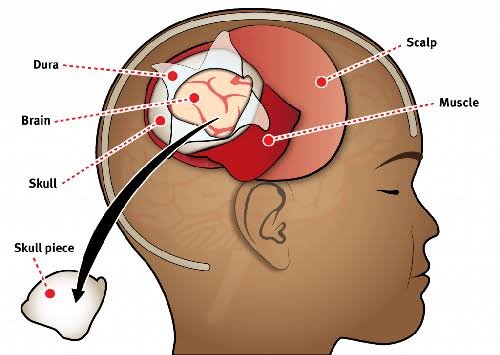
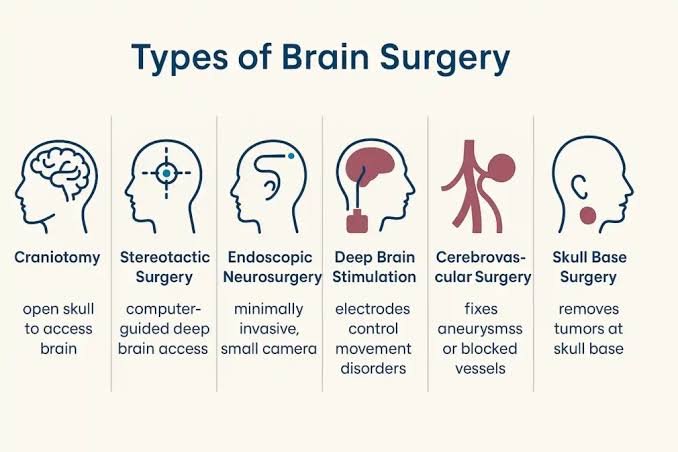
Craniotomy: The temporary removal of a bone flap from the skull to access the brain tissue directly for tumor resection, aneurysm clipping, or clot removal.
Craniectomy: Similar to a craniotomy, but the skull fragment is left off temporarily to allow swelling to reduce (often used in severe traumatic brain injury).
Endoscopic Neurosurgery: Minimally invasive approach using small incisions or natural openings (such as through the nasal cavity to reach pituitary tumors).
Stereotactic Radiosurgery (e.g., Gamma Knife): Non-invasive precision radiation targeted to destroy tumors or vascular malformations without incisions.
Deep Brain Stimulation (DBS): Implantation of electrodes deep within brain tissue to manage movement disorders like Parkinson’s disease.
Key Clinical Indications
| Category | Typical Conditions Treated | Primary Surgical Goal |
| Oncology (Tumors) | Gliomas, meningiomas, acoustic neuromas, pituitary adenomas, brain metastases | Maximum safe resection while preserving surrounding functional tissue |
| Vascular Disorders | Cerebral aneurysms, arteriovenous malformations (AVMs), cavernous malformations | Surgical clipping, embolization, or revascularization to prevent life-threatening hemorrhage |
| Trauma & Emergency | Subdural and epidural hematomas, traumatic brain injury (TBI), depressed skull fractures | Decompression of intracranial pressure, clot evacuation, and skull repair |
| Hydrocephalus & CSF Dynamics | Normal pressure hydrocephalus (NPH), obstructive hydrocephalus, CSF leaks | Shunt placement (e.g., VP shunt) or endoscopic third ventriculostomy to restore fluid balance |
| Functional & Epilepsy | Intractable epilepsy, Parkinson’s disease, essential tremor, dystonia | Surgical resection of epileptogenic zones or Deep Brain Stimulation (DBS) lead implantation |
| Skull Base & Cranial Nerves | Trigeminal neuralgia, hemifacial spasm, chordomas, schwannomas | Microvascular decompression (MVD) or endoscopic skull base resection |
| Structural & Congenital | Chiari malformations, craniosynostosis | Decompression of the craniocervical junction or cranial vault remodeling |
General Procedural Steps (Craniotomy Example)
Pre-Surgical Mapping & Anesthesia
3D MRI/CT neuronavigation setup to map critical brain zones under general anesthesia
↓
Incision & Bone Flap Removal
Scalp incision made and a small section of skull bone temporarily lifted to expose dura mater
↓
Dural Opening & Resection/Intervention
Dura opened; microsurgical resection, tumor removal, or repair performed under magnification
↓
Dural Closure & Skull Reconstruction
Dura sutured watertight, bone flap reattached with titanium plates/screws, and scalp closed