Surgical Treatment of Parkinson's Disease
Surgical treatment of Parkinson’s disease refers mainly to procedures that help control Parkinson’s symptoms when medications no longer provide adequate or consistent relief. Surgery does not cure Parkinson’s disease, but it can significantly reduce symptoms such as tremor, stiffness, slowness of movement, and medication-related fluctuations in appropriately selected patients.
Dr. Sanjeev Srivastava specializes in stereotactic and functional neurosurgery, offering surgical management for advanced Parkinson’s Disease and related movement disorders.
Conditions Treated & Target Anatomy
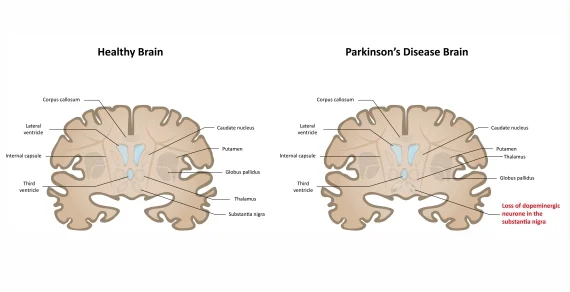
Parkinson’s disease is a progressive neurodegenerative disorder caused by the loss of dopamine-producing neurons in the substantia nigra. When medical therapies (such as Levodopa) cause severe motor fluctuations or dyskinesias, surgical intervention is indicated.
Primary Symptoms Managed: Motor fluctuations (“on-off” phenomena), medication-induced dyskinesia, refractory motor tremors, rigidity, and bradykinesia (slowness of movement).
Target Surgical Structures:
Subthalamic Nucleus (STN): Primary target to reduce motor fluctuations, rigidity, and enable significant reduction in dopaminergic medication dosages.
Globus Pallidus Internus (GPi): Targeted primarily to suppress severe medication-induced dyskinesias and dystonic posture.
Ventral Intermedius Nucleus of the Thalamus (VIM): Targeted specifically when severe tremor is the dominant symptom.
Primary Surgical Modalities
| Procedure | Technique | Primary Indication / Advantage |
| Deep Brain Stimulation (DBS) | Implantation of thin electrodes into subcortical targets (STN/GPi) linked to a subcutaneous Neurostimulator (IPG). | Reversible, adjustable, non-destructive modulation that provides sustained motor symptom control. |
| Ablative Lesioning (Pallidotomy / Thalamotomy) | Precise thermal lesion creation in the target nucleus (via radiofrequency or stereotactic focused ultrasound). | Permanent symptom reduction for non-candidates for hardware implantation or unilateral severe tremor/dyskinesia. |
Surgical Workflow for Parkinson's DBS Treatment
Candidate Screening & Levopoda Response Evaluation
Comprehensive neurological assessment, formal UPDRS scoring in “ON” and “OFF” medication states, and neuropsychological clearance
↓
High-Resolution MRI & Stereotactic Trajectory Planning
3T structural MRI fused with intraoperative CT to map exact target coordinates (STN/GPi) and establish safe trajectory pathways avoiding blood vessels
↓
Microelectrode Recording (MER) & Lead Implantation
Stereotactic microelectrode recording and intraoperative test stimulation performed to confirm precise functional localization before permanent lead fixation
↓
Pulse Generator (IPG) Placement & Post-Op Neurostimulation Tuning
Subcutaneous IPG implantation in the chest, followed by systematic, ongoing programming to optimize stimulation parameters and adjust oral medications