Spine Disorders
Spine disorders are medical conditions that affect the spine (backbone), spinal discs, spinal cord, nerves, muscles, or surrounding structures. They can occur in the neck (cervical spine), upper/mid-back (thoracic spine), or lower back (lumbar spine).
Dr. Sanjeev Srivastava manages a comprehensive spectrum of acute, chronic, and degenerative spine conditions using both conservative protocols and advanced minimally invasive or open surgical techniques.
Core Spine Disorders Treated
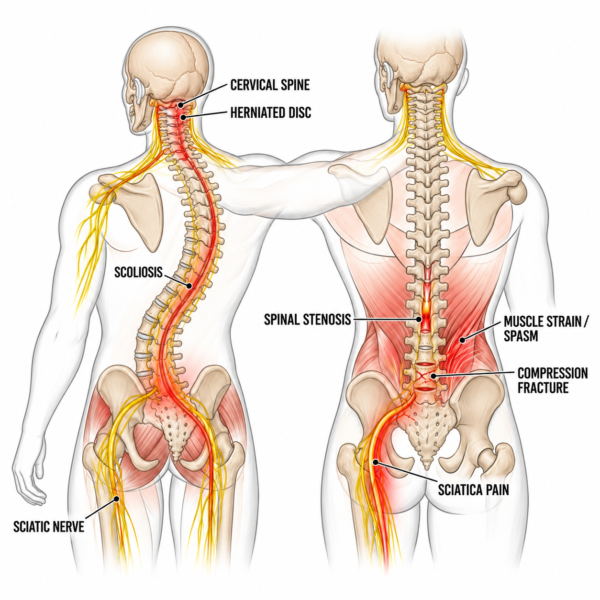
Herniated & Bulging Discs: Displacement of intervertebral disc material in the cervical, thoracic, or lumbar spine causing radiculopathy (sciatica) or severe localized pain.
Spinal Stenosis: Structural narrowing of the central spinal canal or neural foramina, leading to cord or nerve compression, neurogenic claudication, and impaired mobility.
Spondylolisthesis: Slippage of one vertebra over another due to degenerative changes, trauma, or pars interarticularis defects, resulting in mechanical instability and nerve impingement.
Degenerative Disc Disease (DDD): Progressive wear and tear of intervertebral discs causing loss of disc height, chronic axial back/neck pain, and secondary facet joint arthropathy.
Spinal Deformities (Scoliosis & Kyphosis): Abnormal curvature or alignment loss of the vertebral column requiring structural correction or stabilization.
Spinal Trauma & Vertebral Fractures: Traumatic fractures, dislocations, or osteoporotic compression fractures causing spinal instability or acute spinal cord compression.
Spinal Tumors & Vascular Malformations: Intradural or extradural tumors (such as meningiomas, schwannomas, or metastases) and vascular malformations affecting the spinal cord.
Surgical & Interventional Approaches
| Category | Treated Conditions | Operational Goal |
| Minimally Invasive Spine Decompression | Lumbar disc herniation, focal spinal stenosis | Microdiscectomy / Tubular Laminectomy: Relieves nerve root compression while preserving surrounding muscle and ligament integrity. |
| Spinal Stabilization & Fusion | Spondylolisthesis, severe spinal instability, traumatic fractures | TLIF / PLIF / Percutaneous Pedicle Screw Fixation: Restores structural alignment and fuses unstable vertebral segments. |
| Motion-Preserving Spine Surgery | Cervical disc herniation, single-level degenerative disc disease | Cervical Artificial Disc Replacement (ADR): Replaces damaged discs while preserving natural spinal range of motion. |
| Complex Reconstruction & Deformity Correction | Severe scoliosis, kyphosis, complex revision spine surgeries | Multi-level Deformity Correction: Realigns spinal columns using advanced instrumentation to restore sagittal and coronal balance. |
Diagnostic & Treatment Workflow
Clinical Evaluation & Advanced Neuro-Imaging
Detailed neurological exam paired with weight-bearing X-rays, 3T high-resolution MRI, and CT myelography to pinpoint anatomical compression
↓
Conservative & Targeted Non-Surgical Management
Structured physical therapy, activity modification, targeted epidural steroid injections, or facet joint blocks
↓
Minimally Invasive or Complex Surgical Intervention
Preservation-focused surgical decompression, motion-preservation replacement, or hardware-assisted fusion utilizing intraoperative navigation
↓
Post-Operative Rehabilitation & Recovery
Early mobilization protocols, dedicated physical therapy, and routine long-term follow-up to optimize functional restoration